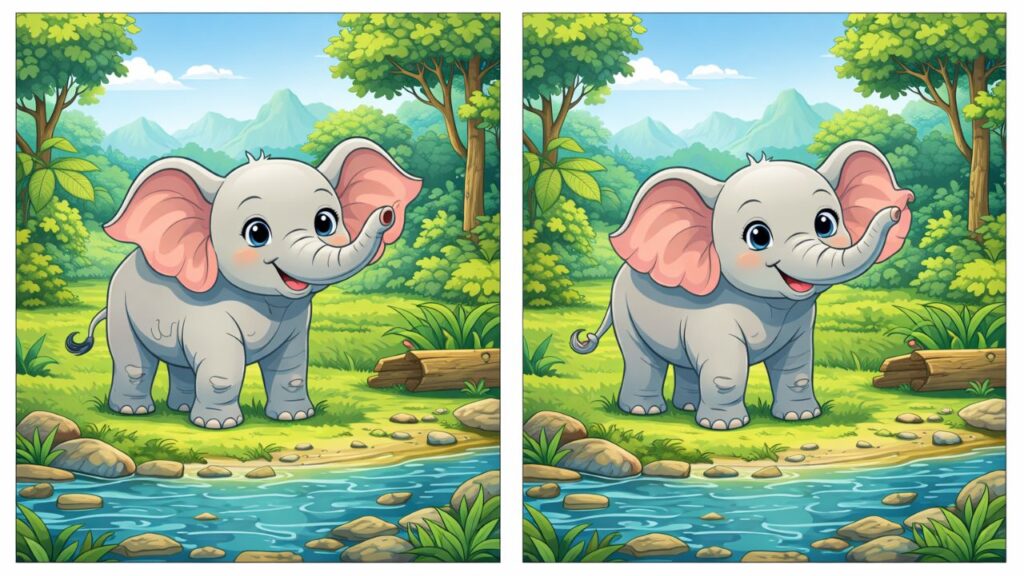
If you enjoy puzzles that test your thinking skills and sharpen your observation abilities then the Spot the Difference game might be exactly what you need. This entertaining game challenges your visual skills by requiring you to identify small differences between two images that look almost identical. It serves as both an enjoyable pastime and a practical method for improving your focus and attention span. In this particular brain teaser you will work with a set of adorable elephant images where your task is to locate three differences in only 10 seconds. This fast-paced activity combines entertainment with mental exercise in an engaging format. The game works by presenting two pictures side by side that appear to be the same at first glance. However careful examination reveals subtle variations in details such as colors or shapes or positions or missing elements. Your goal is to identify these discrepancies as quickly as possible within the given time limit. This type of puzzle offers several benefits beyond simple entertainment.
How “Spot the Difference” Puzzles Actually Work
“Spot the Difference” games are easy to understand but surprisingly engaging. Players are shown two images that look almost the same at first glance. With careful observation, small variations begin to appear—such as an item missing, a color change, or an object placed slightly differently. The objective is simple: identify all the differences before the timer runs out, adding a sense of excitement and urgency.
Most puzzles include a short time limit, sometimes as little as 10 seconds, pushing players to think quickly and stay alert. As you play, you’ll notice that these games naturally improve attention to detail while offering a light yet stimulating mental challenge. They’re enjoyable for all age groups and work just as well for solo play as they do for group fun.

The Elephant-Themed Picture Difference Challenge
This particular “Spot the Difference” puzzle features two images of a charming elephant. Although the pictures appear nearly identical, three small differences are cleverly hidden. Your challenge is to find all three within just 10 seconds.
The fun part is looking at the small details. The differences might be hard to spot but you need to carefully check every section of the picture. Here is how to play:
– Carefully compare details, including the elephant and the surrounding background.
– Pay attention to small objects that may be missing, altered, or moved.
Find all three differences before the timer ends. You need to spot every difference between the two images within the time limit. Look carefully at both pictures and identify what has changed. Work quickly but stay focused to locate all three variations before you run out of time.
This puzzle type works well for building visual awareness and concentration skills. Playing it regularly can strengthen memory and improve your ability to focus. The activity trains your brain to notice details and maintain attention over time.
The Three Differences You’re Looking For
Ready to see the solution? Below are the three subtle differences hidden between the two elephant images. Don’t be discouraged if you missed one or two—the smallest details are often the hardest to notice.
The first image shows a small flower sitting on the left side of the tree stump. The second image does not have that flower anymore.
The left image displays a butterfly sitting on a leaf close to the elephant. In the right image this butterfly cannot be seen anywhere.
The first image shows a small mark or feature on the elephant’s right foot. This detail is missing in the second image.
Each difference is minor on its own, yet together they test your observation skills. Identifying them requires patience, focus, and a sharp eye.
Why “Spot the Difference” Games Benefit Your Brain
Mental Benefits of Spot the Difference Puzzles
 Goodbye Hair Dye for Grey Hair: The Conditioner Mix That Restores Natural Colour Gradually
Spot the Difference puzzles do more than just pass the time. These simple games give your brain a useful workout that keeps your thinking sharp and focused. When you search for differences between two images you engage multiple mental skills at once. Your brain practices concentration as you scan each detail carefully. You develop better visual processing abilities while comparing shapes & colors. Your memory gets stronger as you remember what you saw in one picture while examining the other. These puzzles work well for people of all ages. Children build observation skills that help with reading and learning. Adults maintain cognitive flexibility and attention span. Older players keep their minds engaged in a low-pressure activity that feels more like play than exercise. The beauty of these puzzles lies in their simplicity. You don’t need special equipment or training. You can work at your own pace without time pressure. Each puzzle provides a small challenge that gives you a sense of accomplishment when completed. Regular practice with spot the difference games can improve your daily life. You might notice details you would have missed before. Your ability to focus on tasks may increase. The mental habits you build while playing transfer to other activities that require careful attention. These puzzles also offer a break from screen fatigue when done in print form. They give your mind something specific to focus on instead of wandering. This focused attention can feel refreshing compared to scrolling through endless content. The next time you see a spot the difference puzzle, consider it an opportunity. You’re not just finding differences between pictures. You’re giving your brain a beneficial workout disguised as entertainment.
Regular practice with spotting small changes helps train your brain to pick up on details you might normally miss. This kind of exercise strengthens your ability to pay attention to the little things in everyday situations. When you make a habit of looking for subtle differences you develop sharper observation skills over time. Your mind becomes better at catching minor variations and inconsistencies that other people often overlook completely. This type of mental training has practical benefits beyond simple games or puzzles. You start noticing important details at work & in daily life that can make a real difference in how you handle tasks & solve problems.
– Improves Visual Processing: Closely examining images enhances your ability to interpret visual information accurately.
Time limits help students maintain their attention and make faster decisions. When there is a set amount of time to complete a task students naturally focus better because they know they cannot afford distractions. This structure trains the brain to concentrate more effectively & work through problems without losing momentum. Students learn to prioritize important information and ignore irrelevant details. The pressure of a deadline also prevents procrastination & keeps the mind actively engaged with the material. Over time this practice strengthens mental discipline and improves the ability to concentrate during both timed and untimed situations.
Switching between two images helps you develop cognitive flexibility by training your brain to shift focus more smoothly. This mental exercise strengthens your ability to adapt your attention from one visual element to another without losing concentration. Regular practice with this technique makes it easier to transition between different tasks and ideas in everyday situations.
– Supports Stress Relief: Solving puzzles offers a mental break, helping you relax and unwind.
Tips to Spot Differences More Quickly
If you want to get better at these puzzles, a few simple strategies can help:
Start by looking at the entire image to spot any obvious differences before you examine the smaller details closely. When you first compare two images, take a moment to view them both completely. Notice any major changes in colors, shapes or objects that stand out right away. This initial overview helps your brain register the big picture before getting lost in tiny variations. After you finish this quick scan, you can then move on to checking specific areas more carefully. Look at each section of the image one at a time. Pay attention to backgrounds, foregrounds and middle areas separately. Many people make the mistake of immediately zooming in on small details. This approach often causes you to miss larger and more obvious differences. Your eyes work better when they process information from general to specific. The human brain naturally recognizes patterns & disruptions in those patterns. By viewing the whole scene first, you allow your visual system to work the way it was designed. Large differences will jump out at you almost automatically. Once you identify the major changes you can create a mental checklist of areas that need closer inspection. This systematic method saves time & reduces frustration. You will find differences faster and more efficiently. Remember that obvious changes might include missing objects, different colors, altered sizes or repositioned elements. These are usually easier to spot than subtle shadow changes or minor texture variations. Taking this approach turns a potentially overwhelming task into a manageable process. You build confidence as you find each difference which helps you stay focused on completing the challenge.
– Examine Tiny Elements Closely: Pay attention to colors, patterns, and small objects.
– Check for Symmetry Changes: Differences often involve slight shifts or missing elements on one side.
– Rely on Visual Memory: Remember details from one image as you compare it to the other.
Final Thoughts
Spot the Difference puzzles like the elephant-themed challenge offer a simple way to improve your observation skills and boost your focus. These puzzles are quick to complete and provide mental stimulation while remaining enjoyable. If you need a brief mental break or want a fun challenge these games let you test how well you notice small details whenever you have a few minutes to spare.