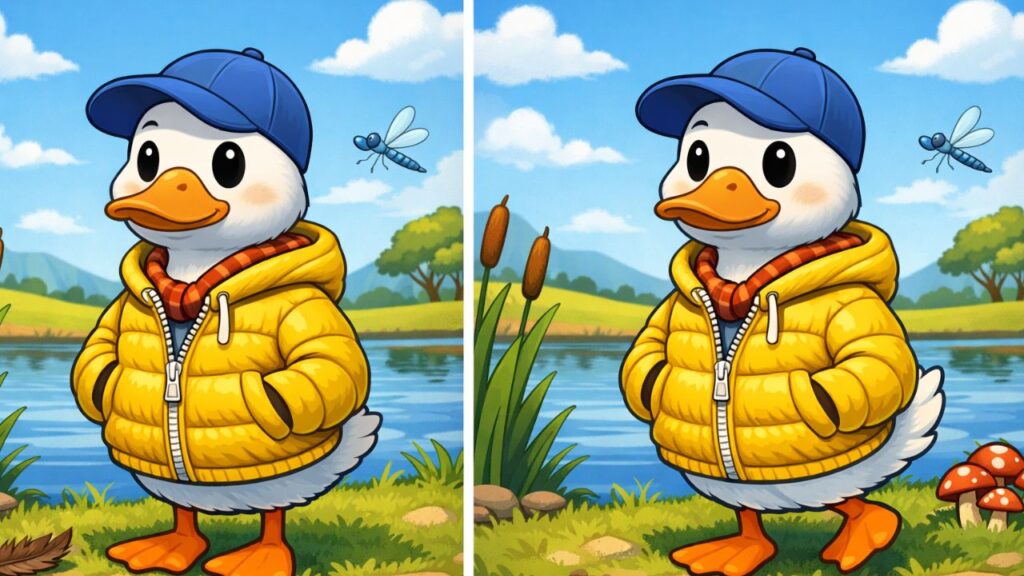
If you like optical illusions and brain teasers then this puzzle is perfect for you. We have created a Spot the Difference challenge that will test how well you notice details & how fast you can think. This visual puzzle shows a cute duck wearing sunglasses and a jacket walking by a peaceful pond. The challenge is to find three small differences between two pictures that look almost the same. Can you find them in just 8 seconds? Only people with very sharp eyes will succeed in time!
Why Spot-the-Difference Games Instantly Grab Attention
Spot the Difference puzzles have remained a popular form of entertainment for decades. They are easy to understand, highly engaging, and surprisingly effective at sharpening cognitive skills. By requiring close attention to small details, these puzzles help strengthen visual perception and boost mental speed. Even though they appear simple at first glance, the challenge increases when differences are cleverly hidden, pushing the brain to work harder.
What makes these puzzles so appealing is their wide-ranging accessibility. They can be enjoyed by children as a playful activity or by adults seeking a quick and stimulating brain exercise. Spot the Difference challenges also support better memory retention, improved focus, and sharper attention to detail, which is why they continue to be loved by puzzle and brain-game enthusiasts alike.
 Achieve Fuller Thicker Brows at Home With an Easy Lamination Routine That Delivers Visible Results
The 8-Second Duck Puzzle That Tests Your Sharpness
Today’s puzzle shows two pictures of a cute yellow duck dressed in sunglasses & a jacket. The duck walks beside a pond in a calm outdoor setting. The images look the same when you first see them but they actually contain small differences.
You need to find three differences in only 8 seconds. This might seem simple but time passes quickly and you must use your observation skills to spot all the changes before the timer ends. The differences are not easy to see so you should examine every part of both images carefully.
Smart Ways to Scan Images Without Missing Details
Ways to Improve Your Observation Skills for Spot-the-Difference Puzzles
Here are some practical methods to enhance your ability to notice details & excel at spot-the-difference games:
Start with systematic scanning. Instead of randomly looking around the image, train your eyes to move in a pattern. You can scan from left to right and top to bottom, or divide the picture into sections & examine each one carefully. This organized approach ensures you don’t miss any areas.
Focus on common difference locations. Changes often appear in specific places like edges, corners or areas with lots of detail. Pay extra attention to objects that seem complex or have many small parts. Background elements and shadows are also frequent spots for hidden differences.
Take short breaks during practice. Your eyes and brain need rest to maintain sharp focus. If you stare at images for too long, your attention starts to fade & you might overlook obvious changes. Step away for a minute or two, then return with fresh eyes.
Practice regularly with different difficulty levels.Begin with easier puzzles that have clear differences, then gradually move to harder ones. This builds your confidence and trains your brain to recognize subtle changes. Try various types of images including photographs drawings, & digital art.
Improve your visual memory.Spend time looking at one image, then cover it and try to recall specific details. This exercise strengthens your ability to remember what you’ve seen and makes it easier to spot when something has changed.
Minimize distractions in your environment. Find a quiet space with good lighting where you can concentrate fully on the puzzle. Poor lighting or background noise can reduce your ability to notice small differences.
Use comparison techniques. Some people find it helpful to look back & forth quickly between the two images. Others prefer to focus on one small area at a time in both pictures before moving on.
Start With a Fast Overview
Begin by giving both images a quick glance to understand the overall layout. This initial scan helps your brain register the main elements before you zoom in on finer details. Look at both pictures briefly to get a sense of what you see. This first look lets your mind take in the basic parts before you search for smaller differences.
Focus on Individual Elements: After the quick scan, compare specific parts of the image one by one—such as the duck’s jacket, the pond area, or nearby objects. Small changes are usually hidden in these focused areas.
Watch for Color, Size, and Shape Changes: Differences often involve slight shifts in color, shape, or proportion. Carefully observe similar objects in both images, as even tiny variations can be the key to spotting a difference.
Use Balance and Symmetry: Puzzle designers often place differences in balanced or mirrored positions. Checking one side against the other can make inconsistencies easier to notice.
Look for Balance & Symmetry: Puzzle creators frequently position differences in balanced or mirrored locations. When you compare one side with the other you will find inconsistencies more easily.

Train With Short Time Limits: Improve your speed by setting a tight timer, such as 7 seconds, and trying to spot the differences quickly. Regular timed practice sharpens your ability to detect subtle details under pressure.
Revealing the Three Hidden Changes in the Jacketed Duck
Now let us examine the three hidden differences in the image more closely. If you are ready to find them here is a clear & detailed explanation of what you should look for:
The first difference appears in the upper section of the picture. Look carefully at the background elements and notice any changes in color or shape. Small details like shadows or patterns might be altered between the two versions. The second difference can be found somewhere in the middle area. Pay attention to objects that seem slightly moved or modified. Sometimes items are removed entirely while other times they just change position or size. The third difference is usually located in the lower portion of the image. Check for variations in textures or missing components. These changes can be subtle so take your time scanning each part of the scene. When searching for differences it helps to divide the image into sections and examine each one systematically. Start from one corner & work your way across rather than jumping randomly between areas. This method ensures you do not miss anything important. Remember that some differences are obvious while others require careful observation. Do not get discouraged if you cannot find them all immediately. The challenge is designed to test your attention to detail & patience.
1. The Rock That Vanishes Near the Grass
The first difference appears in the lower part of the image near the grassy area. In the left image, a small rock can be seen close to the grass, while in the right image, this rock is completely gone. Because it blends naturally into the background, this change is easy to overlook. Carefully examine the area near the duck’s feet to notice this subtle difference.
2. The Hoodie Drawstring That’s Gone
The second difference is located on the duck’s hoodie. In the left image, the hoodie clearly shows a drawstring hanging from the neckline. However, in the right image, the drawstring is missing entirely. Since the hoodie itself looks nearly identical in both images, this small detail can be tricky to catch. Focus closely on the neckline area to spot this change.
3. The Frog Missing by the Pond
The third and final difference is near the pond. In the left image, a small frog is sitting near the water’s edge, adding a tiny but noticeable detail. In the right image, the frog has disappeared. This difference can be missed if you’re not paying close attention, but the frog’s absence is a key clue. Checking the pond area carefully will help you identify this final change.
How Visual Puzzles Quietly Strengthen Observation Power
Spot the Difference puzzles do more than keep you entertained. They actually help your brain work better. When you search for tiny differences between two images you learn to notice small details that you might normally miss in daily life. This skill of spotting subtle changes becomes useful in many situations. These puzzles also train you to concentrate better. The more you practice finding differences the stronger your focus becomes. This improved concentration can help you perform better at work or when studying.
Playing these games regularly makes your brain faster at processing what you see. Your short-term memory gets better too because you need to remember details from one image while comparing them to another. This ability to quickly analyze and remember information comes in handy throughout your day.
Pro Tips to Master Spot-the-Difference Challenges Faster
If you want to improve at Spot the Difference puzzles and find changes faster here are some helpful tips to try. Start by scanning the entire image instead of focusing on one small area. This gives you a better sense of the overall picture and helps you notice obvious differences right away. Many people make the mistake of staring at tiny details too early and miss the bigger changes. Divide the image into sections & examine each part systematically. You can mentally split the picture into quarters or use an imaginary grid. Work through each section carefully before moving to the next one. This organized approach prevents you from looking at the same spots repeatedly while missing other areas. Look for differences in colors first since they often stand out more than shape changes. Objects that appear in different shades or completely different colors are usually easier to spot than subtle size variations. Pay attention to missing or extra objects. Sometimes one image has an additional item that the other lacks entirely. These differences can be tricky because your brain might fill in the gaps automatically. Check the edges and corners of the images carefully. Puzzle creators often hide differences in these areas because people naturally focus on the center of pictures. Take short breaks if you feel stuck. Looking away for a moment & returning with fresh eyes often helps you see differences you missed before. Practice regularly with different types of puzzles. The more you work on these challenges, the faster your brain becomes at recognizing patterns and spotting inconsistencies. Use your finger or a pointer to track your progress across the image. This physical guide helps ensure you examine every part thoroughly without skipping sections. These strategies will help you become more efficient at solving Spot the Difference puzzles over time.
Practice Regularly: Consistent practice helps train your eyes and brain to recognize even the smallest variations. The more puzzles you solve, the faster and more accurate you’ll become.
Train with a Timer
You can recreate the 8-second challenge by using a timer when you practice. When you push yourself against the clock you will build speed & keep your focus sharp. This method also helps you maintain precision while working faster. Set your timer for 8 seconds and complete the task before it runs out. This creates pressure similar to real situations where you need to work quickly. The time limit forces you to concentrate fully on what you are doing. Practice this way regularly to see improvement. Your brain adapts to working under time constraints & finds faster ways to complete tasks. You will notice that actions become more automatic over time. Start with simple tasks & gradually increase difficulty as you get better. The timer keeps you honest about your progress and shows where you need more work. Track your results to see how much faster you become each week.
Look carefully at the small things in each image. Many differences appear in areas that are hard to notice right away. Check patterns and textures closely. Study the outlines of objects and examine tiny details that you might miss when you first look at the picture.
Move on to Advanced Puzzles: Once you feel confident working with basic images you should challenge yourself with puzzles that feature more intricate and detailed scenes. Taking on these harder puzzles will help you develop stronger observation skills and enhance your overall ability to notice visual details.